


What Does a Beginner Kitesurfing Course in Ometepe Actually Look Like?

Somebody flies past the beach at thirty knots, hanging off a kite, and you think: I want to do that.
Then you think: how on earth do you start doing that?
It’s a fair question, and the honest answer is more structured and less alarming than most people imagine. There’s no getting dragged down a beach, no being thrown in at the deep end, and no point at which anyone hands you a board and wishes you luck. Here’s exactly how the hours of our beginner kitesurfing courses break down.
First kitesurfing course in Ometepe: three hours
The first 45 minutes, on the beach

Your course starts with your instructor and the equipment on the beach.
We go through the spot: where the wind’s coming from, what it’s doing today, where you can and can’t ride, and how to read conditions for yourself — the assessment every rider makes before they touch their gear. Then the equipment. How to unpack and pump the kite, how to hold and carry it and the wind window — the invisible map of where the kite can fly and where it makes power.
Then the bar and the safety systems. Where the quick release is, what happens when you pull it, and how to activate it without looking. You’ll practise it more than once. This is the single most important 45 minutes of your kitesurfing life, and it’s the part every shortcut-taking beginner regrets skipping.


The next two hours, in the water with short lines

Once the theory’s done, you’re in the water.
We don’t use trainer kites. You learn on a real kite flown on shortened lines, which generate less power, but have the same feel, the same bar, the same responses you’ll get later on full lines. The muscle memory you build transfers directly instead of having to be relearned.
Standing in shallow water, you’ll fly with two hands, then one. You’ll walk with the kite. Then you'll move onto other fun exercises like body-dragging in both directions, letting the kite pull you through the water, and power strokes — learning how to steer the kite through the power zone to generate real pull on demand.

The last 15 minutes, packing down and debrief
The last 15 minutes come back to land: packing the kite and bar down properly, and a debrief with your instructor on what worked and what to focus on next.
That’s the three-hour discovery class. You’ve learnt about security and safety, flown a kite, created power with one to pull you through the water, and learned to shut it all down safely.
Hours four and five — the same skills, full power
Every class after the first is two hours, because the beach theory is behind you.
This one repeats the same exercises — kite control, body-dragging, power strokes — but on long lines. Everything is bigger. The kite is further away and generating far more pull. The point of this session is feeling how much power the kite can make on command, because that’s what’s going to lift you out of the water later.
If your kite control is solid by the end of it, this is where you get handed a board and try your first waterstarts.

Hours six to nine — waterstarts and first rides
Four hours, in two-hour blocks, dedicated to getting on the board and riding.
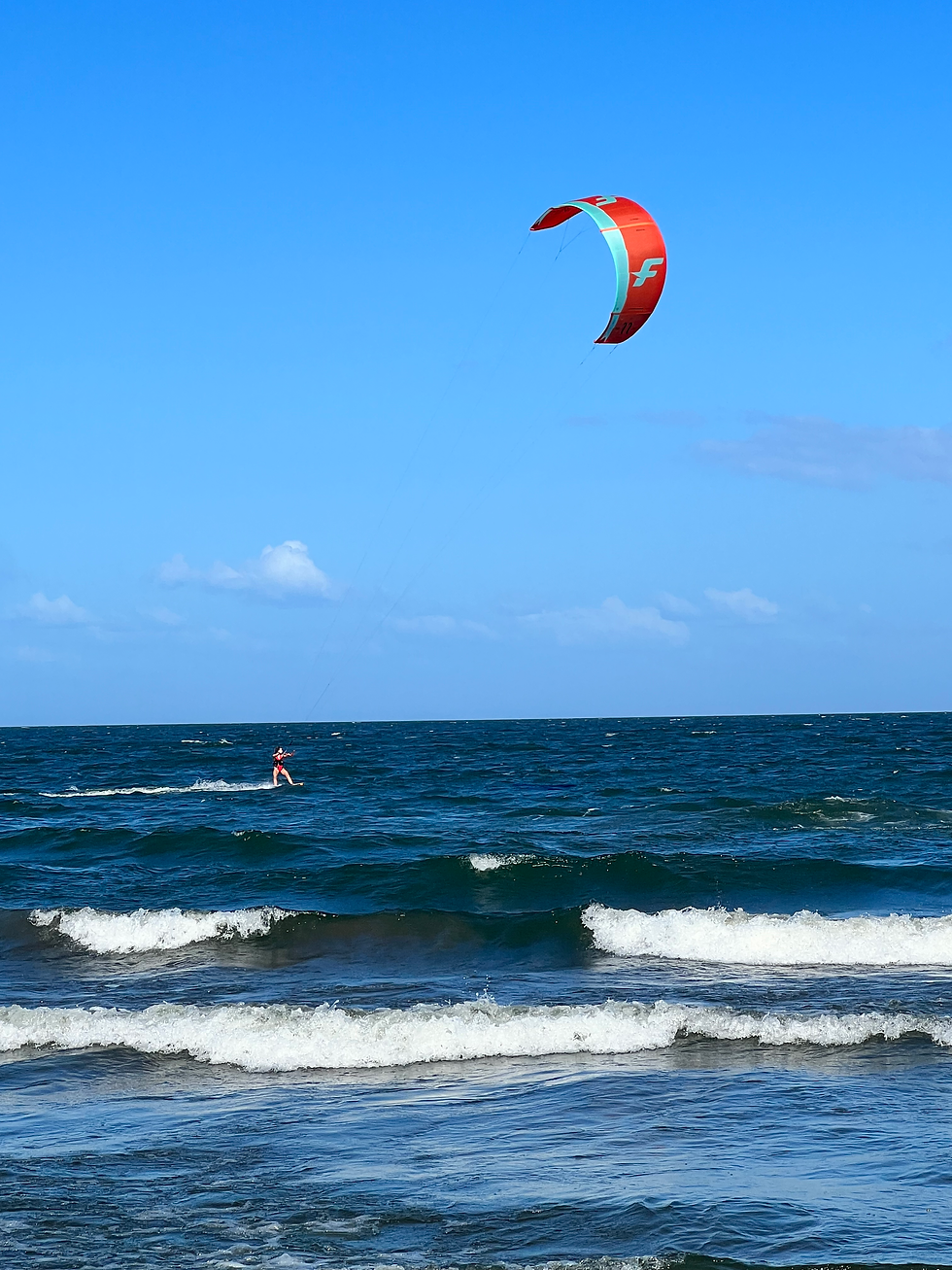
The waterstart is kite steered down through the power zone, board pointed slightly downwind, and up onto the water. The first attempts don’t always work. Then one does, for about three metres. Then twenty. Then you're riding downwind and experiencing the amazing sensation of gliding across the lake.

From there we work on getting up consistently rather than occasionally, controlling your speed by edging the board, and stopping under control — then the beginnings of riding upwind, which is what turns kitesurfing from a downwind drift into something you can actually do all afternoon.
Hours nine to twelve and more— becoming independent
The last block is about refinement.
Body position. Timing between what the kite’s doing and what the board’s doing. Edging properly. Riding upwind well enough to get back to where you started, and transitions to change direction without stopping — which is the moment you stop needing anyone to walk down the beach and fetch you.
This is when you become an independent rider: launching, riding, coming back to the same spot, and packing down on your own.
How long does it take to learn?
Most complete beginners are riding somewhere between 9 and 12 hours of lessons. Some get there faster. Plenty take longer, and that’s not a failure — it depends on how much water time you get, how consistently you practice (i.e. not too many breaks between classes), and how quickly the coordination clicks.
That’s why the courses come in blocks of 3, 6, 9 and 12 hours, following the IKO progression. Three hours gets you through discovery. Six gets you to your first waterstarts. Nine to twelve and above is what it takes most people to ride independently.
The honest advice: don’t book three hours expecting to ride. Book three hours to find out whether you want the other nine.

What do I get at the end?
An IKO card recording the level you reached, recognised at IKO schools worldwide. Every stage is assessed before you move on, so the level on the card means something. If your next kite trip is Costa Rica, Panama, or anywhere else in the world, you don’t start from zero.
What makes Ometepe a good place to learn?
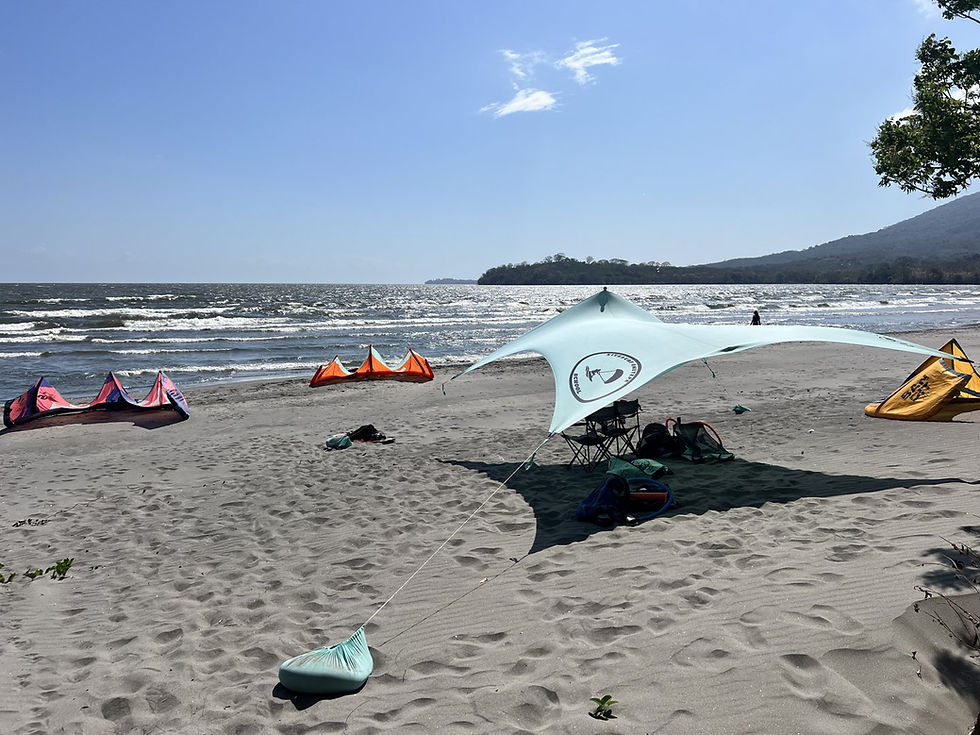
The water is fresh: no salt in your eyes, no swell to fight, warm enough that you’ll never see a wetsuit. The bottom is soft volcanic sand with no reef and no currents. And the wind is on- and side-shore, so it pushes you back toward the beach rather than out into the lake.
Add a long shallow stretch you can stand up in, and the fact that you’re rarely sharing the water with more than a handful of riders, and it’s a great place to start your kitesurfing adventure.
When should I come?
The season runs November to May, with the most reliable wind from December to April, typically 15–25 knots.
It has a daily rhythm worth planning around: wind in the morning, dropping around the middle of the day, returning late afternoon. Lessons are scheduled around it.
How are lessons taught?
Private one-on-one or in a pair, never a large group, so you have your instructor’s full attention and get as much time as possible with the kite in the water. You’ll wear a helmet with a radio on top, meaning your instructor is talking to you the whole time you’re on the water, plus a buoyancy aid. The kites are new F-ONE equipment and bars have modern quick-release systems.
Lessons are taught in English, French, Spanish, Dutch and German.

What if there’s no wind?
It happens, even in season. If there isn’t enough wind to teach in, we reschedule and you don’t lose the hours.
So build a couple of spare days into your trip rather than booking your course for the two days before your ferry. And a windless day on Ometepe is hardly a wasted one: the volcanoes, the waterfall at San Ramón, Ojo de Agua, or a kayak up the Río Istián. In additional, there is plenty of local and international cuisine to sample on the island.

Ready to start?
Courses run November through May. Message us with the dates you’re considering and we’ll tell you honestly what the wind tends to do that month and how many hours you’ll want. With our beginner kitesurfing course in Ometepe, we'll take you from zero to hero in no time!
Come for the rides, stay for the vibes.


Comments